Monday starts with manual exports
Before any analysis happens, someone spends half a day pulling CSVs from five different systems.
Your weekly or monthly numbers mean pulling exports from five systems, patching them together by hand, and hoping the formulas didn't break since last time.
The signs usually show up in day-to-day work long before anyone names the problem.
Before any analysis happens, someone spends half a day pulling CSVs from five different systems.
The output depends on a spreadsheet only one analyst fully understands.
By the time the figures reach leadership, the underlying data has moved on.
Someone asks for the numbers cut a different way, and the whole spreadsheet gets rebuilt from scratch.
Each source system needs its own export, its own cleanup, and its own quirks remembered from last time. None of it is analysis, it's just getting the data into one place, and it happens again next cycle.
This usually starts as a reasonable shortcut: a spreadsheet gets the first set of numbers out the door fast. But as the business adds systems and the cadence tightens, that spreadsheet never gets replaced, it just gets more formulas bolted on. There's no pipeline moving data automatically, no shared model to build from, and no one has had the time to step back and fix the root cause while the next cycle is already due. Left alone, the cost compounds:
Skilled analysts spend most of their week on data entry instead of analysis.
Delivery cadence is capped by how fast one person can manually rebuild a workbook.
Finance and ops can't move to faster decision cycles because the process itself is the bottleneck.
We replace manual exports with ETL/ELT pipelines that pull, transform, and load your data on a schedule, handling schema changes and failures without someone babysitting it.
Instead of one spreadsheet per question, we architect a warehouse modelled around the questions your business actually asks.
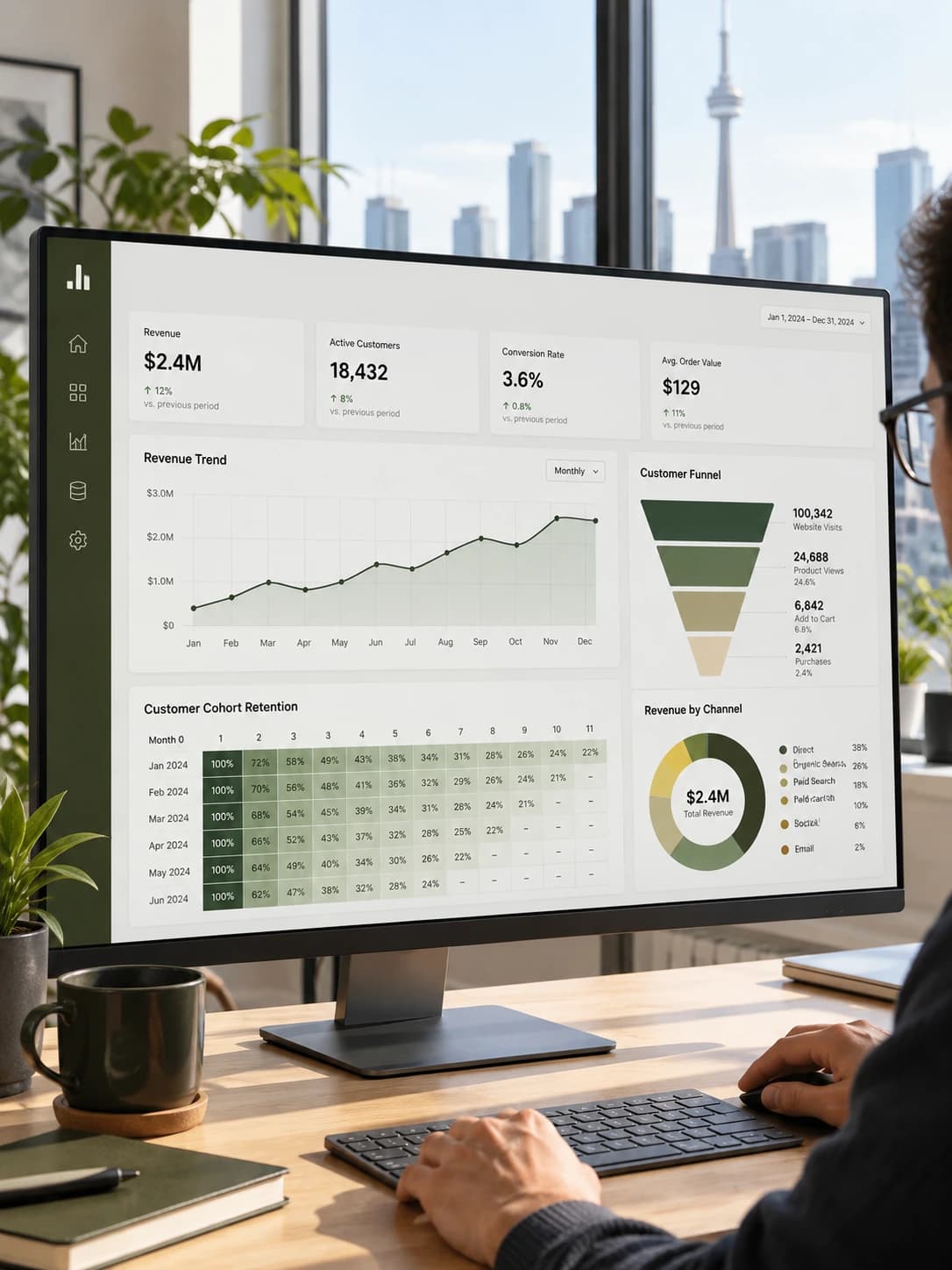
Dashboards replace rebuilt spreadsheets, so a new cut of the data is a filter, not a week of work.
With extraction and modelling automated, your team's time shifts from data wrangling to the decisions the data is actually for.
What day-to-day work looks like once the fix is in place.
Tell us what goes into your current process, and we'll show you what automating it would look like.